Painting Bitten by a Man
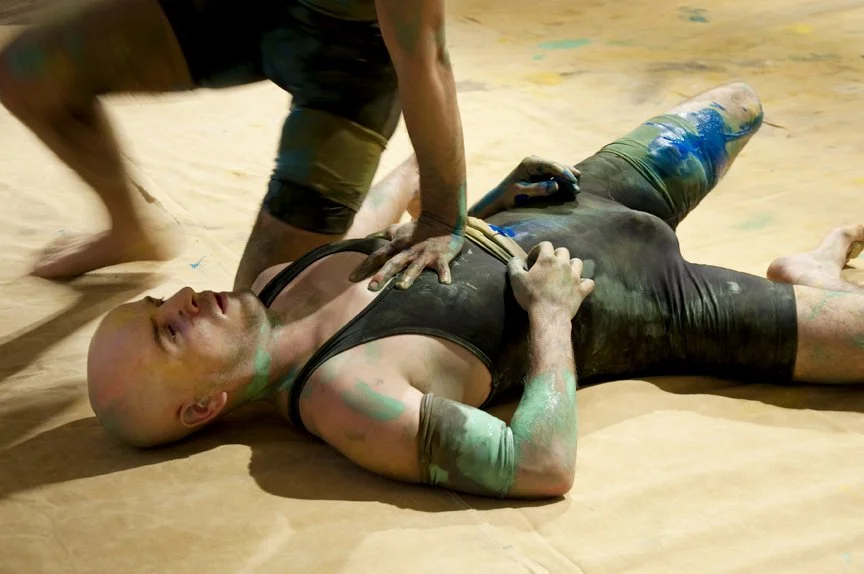
Brian Kokoska and Jonathan Vandyke
Friday, June 1st, 2012 - Sunday, July 1st, 2012
Painting Bitten by a Man was a two-person exhibition of artists Brian Kokoska and Jonathan VanDyke, both of whom work with paint, queering both its historical resonance and contemporary application. Both artists manipulate the medium to embody a push and pull between concealment and display, perhaps even “perverting” the very act of disclosure – the disclosure of hidden histories, rumors and fantasies, and “private” sex acts – in relation to painterly gestures and re-presentation. Their diverse bodies of work present a harmonious but complex merging of two distinct “painting” styles and introduce individual contemporary queer sensibilities through various approaches to figuration, abstraction, and materiality.
Jonathan VanDyke, on opening night, presented the site-specific Cordoned Area, a three-hour performance for two dancers (who are also lovers). Their sometimes-affectionate, sometimes-violent interactions result in a “painting” on both their costumes and the gallery architecture, as they move among gallery-goers. A series of his wall-mounted sculptures also “perform,” dripping paint directly onto the gallery floor for the duration of the exhibition. Complimenting this work is a durational video and a group of photographs entitled Equivalents, in which historical, academic images from art books are paired with suggestively homoerotic images of men at play.
Brian Kokoska was represented by a large and varied selection of paintings from the past four years, marked by both a sexual explicitness and a child-like, finger-painting aesthetic that draws upon and delves into both figuration and abstraction. His images are at once celebratory and sinister, imaginary and dripping with desire. A new series of never-before-seen figurative sculptures will compliment and complicate his two-dimensional works.
The title of the show comes from a rarely seen 1961 Jasper Johns painting of the same name, a timidly erotic/pornographic image, an encaustic monochrome from which Johns has literally taken a bite. This work remained until recently in Johns’ personal collection and was shown very infrequently, evoking a complicated self-censorship interrupted by a perhaps unavoidable impulse to display. Johns, of course, coming of age in a pre-Stonewall, pre-AIDS-crisis New York art world, had a relationship to queerness that is no longer tenable. This exhibition poses the question: What are contemporary artists’ reactions to the interplays and intersections among art, sex, public and private acts, representation, and history, given our contemporary situation?